I have always been drawn to art that has a twist, a joke, or a little secret. I love to explore ways to make designs that are traditional in appearance, but not in subject matter. Enter the Domestic Zombies. Victorian gothic manor house meets pop culture horror.
Since one of the colorways is delft blue, I went looking for its history. What I found was four hundred years of questionable behavior. Delft blue decor reads as inherited money. Blue and white china throughout a house with more history than paperwork.
This inheritance, like so many before it, has a criminal record.
Piracy Begets Porcelain Perfection
In 1603, the Dutch robbed the Portuguese, and all of Europe talked about it for years. But not for the reason you would expect. It wasn’t the theft, it was the cargo. Chinese porcelain had entered the scene.
The stuff was thin enough to hold up to a window, hard enough to survive a sea voyage, and whiter than anything anyone in Europe had managed to produce, and that includes the royal offspring. Nobody on the continent could make it, because the recipe was six thousand miles away, guarded by a language barrier and a dynasty that had no reason to share.
Predictably, Europe lost its mind. Everyone developed a genuine clinical dependency, and the French eventually had a name for it: porcelain sickness. A century later, Augustus the Strong traded a regiment of soldiers for a set of Chinese vases. Six hundred men, for the dishes. They called the stuff kraak porselein (that’s Kraak, not Crack, cheeky). It was named after the ship they robbed, and museums still call it that. Nobody has ever minded.
No Ming, No Porcelain
The Ming dynasty fell in 1644. The kilns at Jingdezhen went dark, and the ships stopped coming.
Europe was mid-obsession with nothing to feed it. Demand does not politely wind down when supply disappears. It goes looking.
If You Can’t Take It, Fake It

Which brings us back to the Dutch. Potters in Delft had already found a workaround, and a lot of empty real estate for production. Breweries had gone bust and the buildings were repurposed. That is why the great potteries of Delft are named The Claw, The Peacock, and The Golden Flowerpot. Nobody bothered changing the signs.
Take a red earthenware body, the same unglamorous clay you would use for a flowerpot. Pour an opaque white tin glaze over it so the clay disappears completely. Paint cobalt blue directly onto that raw glaze. Seal it under clear glaze. Fire it. It is not porcelain. It has never been porcelain. It is a flowerpot in full makeup.
But across a dining room, by candlelight, in the hands of a guest who has had some wine, it passed. Which was the entire business plan.
Delft, it turns out, was already in this story. Remember our original theft? Seizing a ship in peacetime is piracy. The Dutch had no interest in that reputation. So back in 1603, a young lawyer was hired to explain why it was nothing of the sort. His argument became a founding text of international maritime law, and it is still in use. His name was Hugo Grotius, and he was born in Delft.
Still Faking It
The early work copied Chinese scenes line for line, painted by men who had never been within six thousand miles of China. What came out was part copy, part invention, and part confident guessing. An entire country reconstructed secondhand from the dishes.
Eventually they gave up and painted what was outside the window instead. Windmills. Ships. Cattle. Tulips. The neighbors.
Refined but Rotting
Another hundred years go by and the invented landscapes of Asia have been replaced with the ruins of classical antiquity. The capriccio was all the rage as a subject in the eighteenth century. A crumbling estate framed in a scrolled cartouche. Broken columns, a collapsed arch, and ivy handling the rest.

The height of taste was hanging a picture of somebody else’s house falling down, over your own fireplace, where guests would compliment it. Decay, rendered small, framed, and dusted on Sundays. Nobody found this morbid. They found it refined. It was gothic before anyone thought to call it that, and your great-great-grandmother was working an aesthetic you would get side-eye for at Thanksgiving, with the good china to back it up.
Make a thing beautiful enough and nobody asks what it is a picture of. This is the arrangement, and it holds: gorgeous buys permission. The ruins are the easiest example to point at. They are nowhere near the worst.
Made It
Delft’s run ended on price. From the 1760s, English creamware arrived (Wedgwood chief among them) lighter, harder, cheaper, and identical piece to piece. You cannot out-hustle a factory.

Thirty-three potteries thinned, folded, and went dark, until one was left standing: De Porceleyne Fles, founded 1653, still going today as Royal Delft.
And then the thing happened that happens to any forgery that outlives its own con. Nobody buying delft now is trying to pass it off as Chinese. They are buying delft, on purpose, because delft became its own heirloom. The counterfeit got promoted.
It is now what people inherit. Along with the house, and everyone still in it.
Delft Blue, but Keep It Gothic
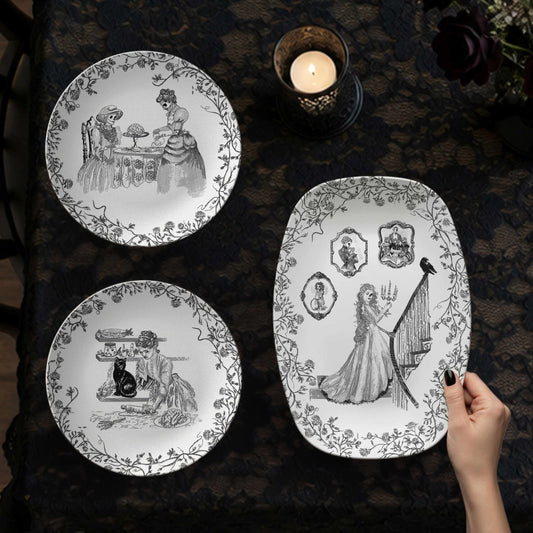
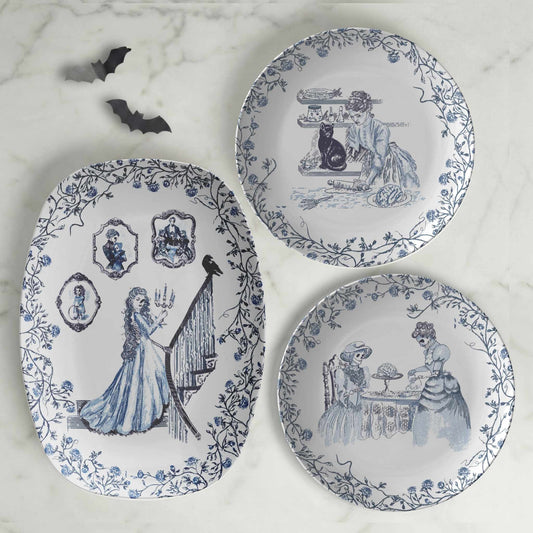
And now back to me. Three gothic delft blue patterns, every line drawn by hand in the style of an engraving.

Domestic Zombie Delft Toile Mug
This is the household. A dead debutante coming down the staircase with a candelabra, raven on the newel post. Tea being poured at a table where one of the two women present is noticeably further along than the other. A kitchen where the cook is rolling out dough beside a brain on a plate, and the cat has taken the entire situation in stride. Roses running through all of it. And the classical ruin over the mantel, because standards are standards.

Domestic Zombie Portrait Gallery Mug, Delft Blue
This is the ancestor wall, which is where a family keeps its receipts. The patriarch, his wife, and their four children, all posed correctly and most of them skeletal (I did say the ruins were not the worst of it). A stag on a heap of bones looking pleased with itself. A dog holding a raven in its mouth, and no one is addressing it. An officer whose ribs have come through the dress uniform. And two frames over, the same crumbling estate, because they had taste.

Domestic Zombie Icons Mug, Delft Blue
This is the house broken into parts and scattered. Cats, crows, roses, candlesticks, loose bones, a teapot pouring a cup nobody is going to drink, and a brain served on a footed cake stand like the hostess is very proud of it. Reads as a pretty blue ditsy print from across the room. Reads as an inventory up close.
More arriving in delft as the collection grows.
The Blue Blood. Good china, bad intentions.